

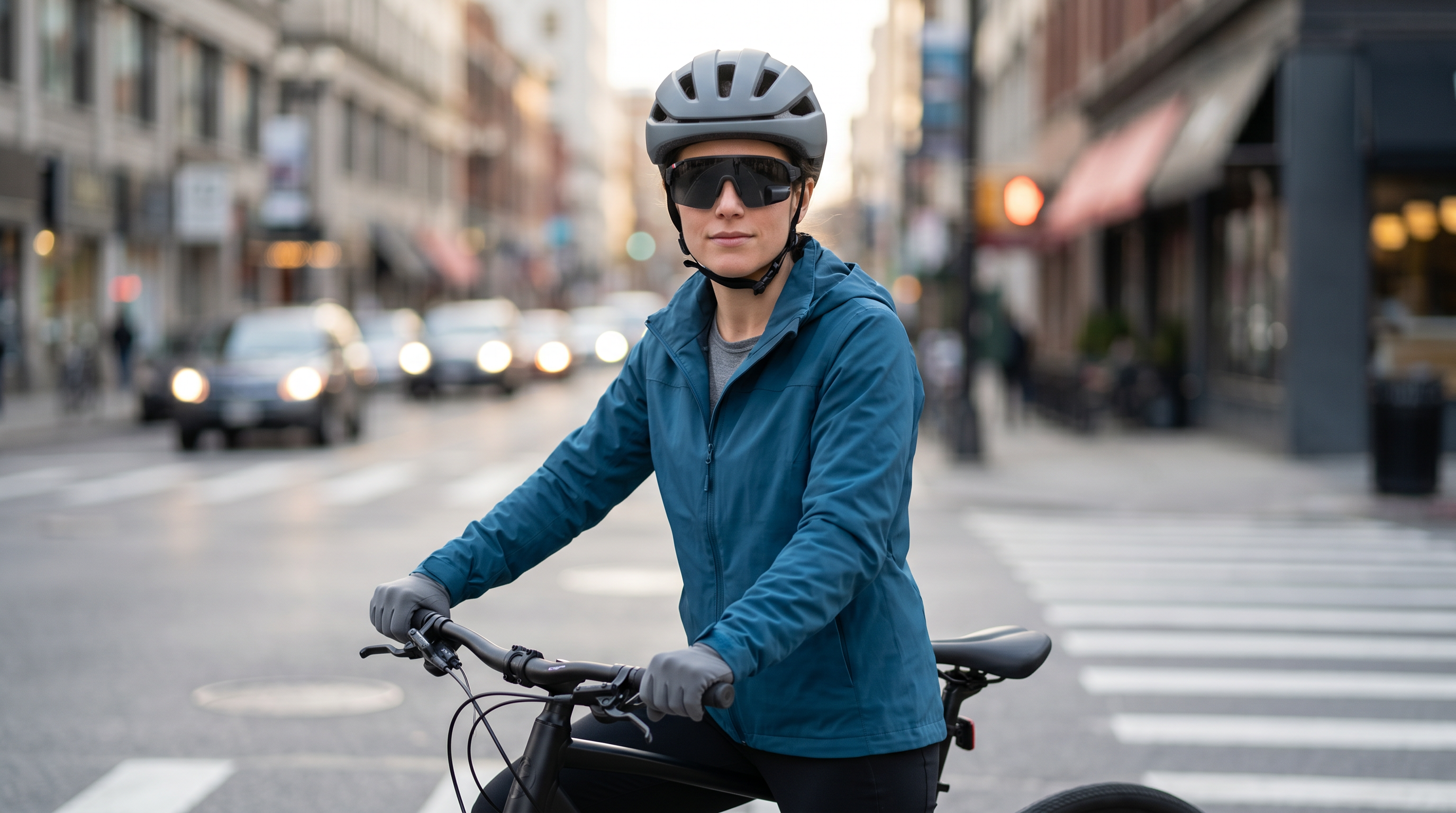
Commuting safely in city traffic comes down to knowing what's around you — especially behind — before you move. Most close calls happen at junctions and lane changes, exactly where a shoulder check leaves you blind to the front. Hold a confident lane position, ride predictably, run lights day and night, and keep the road behind you covered with a glance instead of a head-turn. A rear-view mirror built into your lens makes that glance free — eyes forward, traffic accounted for.
You know the city commute by feel. The bus that pulls out without indicating. The car door that could swing open from the line of parked cars on your right. The taxi closing on your wheel while you're trying to read the light ahead and the cyclist filtering up your inside. A morning ride across town isn't one big danger — it's a hundred small ones, all asking for your attention at once.
More of us are riding it than ever. Strava logged 550 million miles of bike commutes in 2025, with 43% of its riders recording at least one commute that year. Whether you're on a bike, an e-bike, or an e-scooter, the skill that keeps you steady in traffic is the same: awareness. Here's how to build it — calmly, without spending your whole ride looking over your shoulder.
Where's the real danger when you commute in the city?
City riding concentrates risk at junctions and lane changes — the moments where paths cross. According to NHTSA's 2023 cyclist data, 81% of cyclist fatalities happened in urban areas, and 28% occurred at intersections. The city is simply where most of us ride, and where the most decisions get made per minute.
That's worth sitting with, because it reframes what "being careful" means. The classic fear is getting hit from behind on the open road — and a rear hit is severe when it happens — but in town, the stuff that catches commuters out is usually a turning car, a driver changing lanes into you, an opening door, or a vehicle pulling out from a side street. These are situations where what's around you matters more than raw speed. The rider who knows the bus is sitting just off the back wheel makes a different decision than the one who doesn't.
| City situation | What's happening | How to stay ahead of it |
|---|---|---|
| Junctions & turns | A driver turns across your line or pulls out from a side road. | Make eye contact, claim your space, and know what's behind before you adjust line. |
| Changing lanes | You move out to pass a parked car or take a right; traffic is closing behind. | Check behind early, signal clearly, then move — never move and check. |
| The door zone | A door opens from a parked car as you pass on the inside. | Ride a door's width out — but only after you've checked the lane behind is clear to do so. |
| Overtaking traffic | A bus or van squeezes past with little room. | Hear it, see it coming in a mirror, hold your line — don't drift toward the kerb. |
| Filtering & stop lines | You move up the inside in slow traffic; vehicles start moving again. | Filter only when you can see space ahead and behind, and never up the inside of a turning lorry. |
Why "just look over your shoulder" falls short in traffic
A shoulder check works, but it has a cost: for a moment, you're looking the wrong way. Turn your head at 25 km/h through a busy junction and you stop watching the one thing that's actually about to change — the road ahead — while your bike drifts slightly off line.
In open country that lost moment is harmless. In city traffic it's the exact second a light changes, a pedestrian steps off the kerb, or the gap you were aiming for closes. The shoulder check is also tiring to repeat: a real commute needs a glance behind every few seconds in heavy traffic, and most riders quietly stop bothering after the first few. The honest fix isn't to crane your neck more — it's to make checking behind cheap enough that you'll actually do it every time.
What habits keep city commuters aware?
Five habits do most of the work: position yourself to be seen, ride predictably, light up day and night, scan in a rhythm, and keep the road behind you covered. None of them are about riding scared — they're about riding informed.
Predictability is the one drivers reward most. The League of American Bicyclists puts it plainly in its commuting guidance: be visible and predictable, and "check behind you well before turning or changing lanes." When a driver can read your intentions — a straight line, a clear signal, a confident road position — they can give you room. Weaving between parked cars or darting across lanes does the opposite.
Lights belong on your bike even at noon. A steady front white and a blinking rear red make you readable from distance, and a daytime running light measurably raises how early drivers pick you out of a busy scene. Pair that with a lens that suits city light — a lighter tint for shadowed streets and tunnels, a darker one for glare off glass and wet tarmac. And build a scan rhythm: ahead for the decision points, around for the cars filtering past, behind before every move.
How does a rear-view mirror fit a city commute?
A mirror turns the look back into a flick of the eyes — you stay facing forward while you check the lane behind. It won't ride the bike for you or prevent a crash, but it removes the one blind direction and the head-turn that comes with it.
TriEye builds the mirror straight into the lens of the glasses you're already wearing, so there's nothing bolted to your bars or helmet to knock out of alignment. A small glance tells you whether the bus is sitting on your wheel before you move for the parked cars, whether it's clear to take the lane for a right turn, whether that taxi has actually backed off. For the commuter who wants one pair that looks at home on and off the bike — at the desk, in the café, on the walk in — The Classic ($99) puts that mirror into an everyday frame. If your commute is faster or sportier, the wraparound The View ($89) does the same job in a performance shield.
A mirror is one layer, not the whole answer. It pairs naturally with your ears, your lights, and good road position — think of it as the layer that covers the direction you can't see without turning. For the bigger picture of reading traffic in town, see our guide to situational awareness on the bike, and if you're commuting on two small wheels, e-scooter and commuter safety.
Building your awareness stack
Stack your awareness in layers so no single sense carries the whole load: hearing for what's approaching, eyes forward for decisions, a mirror for behind, and lights so others see you first. Each layer covers a gap the others leave.
In practice that means keeping at least one ear open — skip the noise-cancelling buds for the commute, or run bone-conduction so traffic still reaches you. It means positioning where drivers expect to find a vehicle, not hugging the gutter where you vanish. It means a quick rear glance baked into every lane change. And it means trusting your light setup to do the work of being seen, so your attention is free for the road. Stacked together, these turn a chaotic city ride into something you read rather than react to — calm, forward-facing, and rarely surprised.
FAQ
Where do most city cycling crashes actually happen?
In urban areas and at junctions. NHTSA's 2023 data shows 81% of cyclist fatalities occurred in urban settings and 28% at intersections — which is why reading what's around you at crossings and lane changes matters more in town than raw speed does.
Do I really need a mirror if I check over my shoulder?
A shoulder check works but takes your eyes off the road ahead for a moment — risky in busy traffic where the scene changes fast. A mirror makes the same check a glance, so you stay facing forward. Many riders use both: a mirror for constant awareness, a shoulder check to confirm before a big move.
Is The Classic good for everyday commuting and not just sport?
Yes — The Classic is an everyday frame with the rear-view mirror built into the lens, so it looks at home off the bike too. If your commute is faster or you want a wraparound sport fit, The View covers the same need in a performance shield.
Should I run lights during a daytime commute?
Yes. A steady front white and a blinking rear red help drivers pick you out earlier in a cluttered city scene, day or night. Lights and a mirror do different jobs — one helps others see you, the other helps you see them.
Can I commute safely with earbuds in?
Keep at least one ear open, or use bone-conduction headphones so traffic still reaches you. Hearing is one of your awareness layers; a mirror covers the blind direction behind you, so together your sight makes up for what closed-off sound takes away.

