

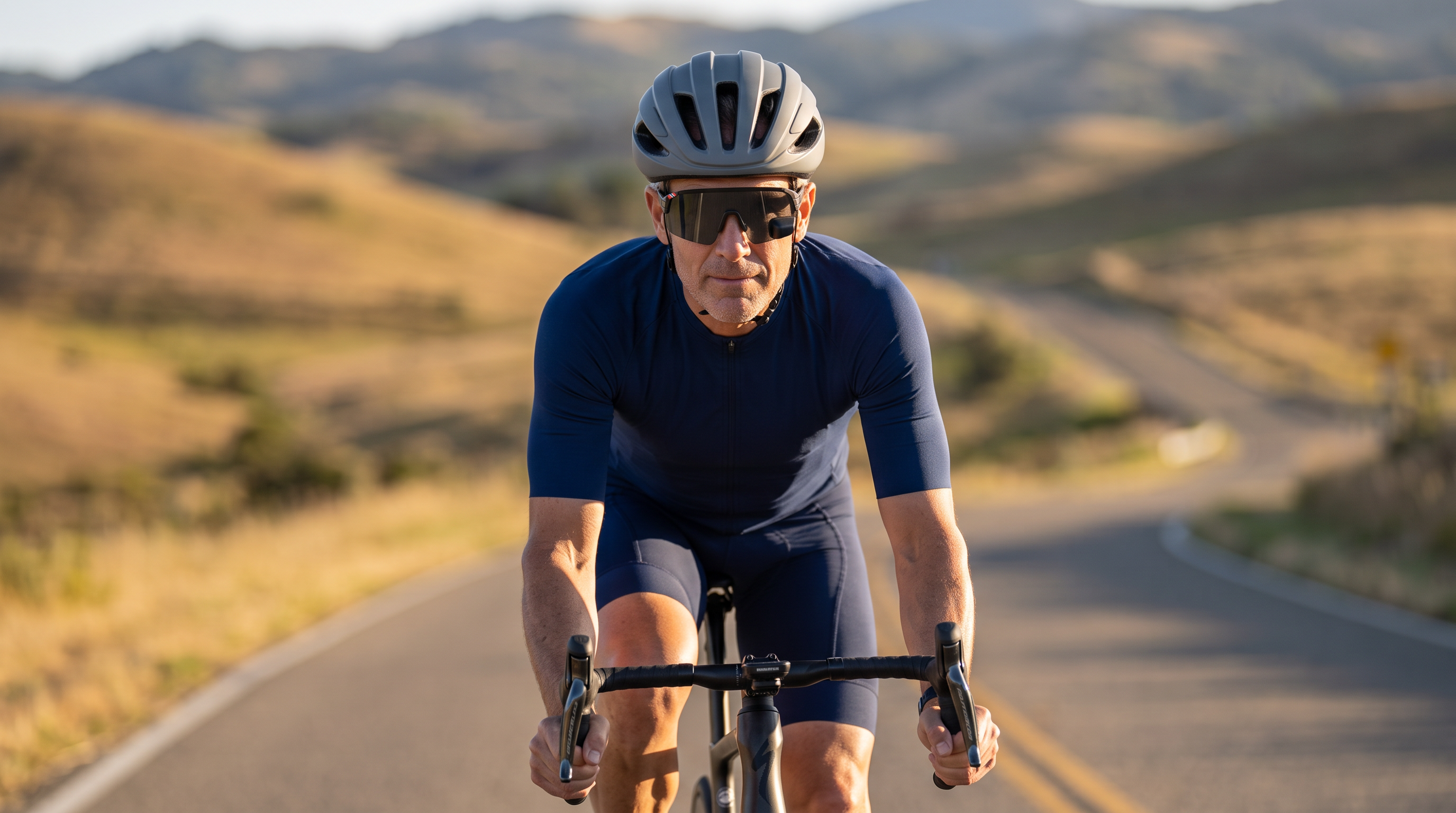
Dr. Jim Taylor is a sport psychologist, 2× Ironman and 5× US national age-group champion who rides with a rear-view mirror built into his sunglasses lens. He tried helmet-clip and bar-end mirrors first and rejected both — poor field of view, and in his words, they "looked totally geeky." He was hit by a car on a training ride in 2021. He now treats rear awareness as part of his kit, not an accessory.
Most people who take safety seriously came to it the boring way: they read something, they bought something, they moved on. Jim came to it the other way. He spent a career teaching Olympians how the mind holds up under pressure, went looking for a mirror because shoulder-checking annoyed him — and then, in 2021, got hit by a car on a day he'd left the mirror at home.
He's not a TriEye employee. He's a customer who wrote to us, and then kept writing. This is his story, in roughly his own words.
Who is Dr. Jim Taylor?
Jim Taylor holds a PhD in psychology and has spent his career as a sport psychologist, working with athletes from juniors to Olympians. He is also a lifelong endurance athlete — which is the part that matters here.
He has consulted for the US and Japanese ski teams, the United States Tennis Association and USA Triathlon, and he writes the long-running Power of Prime blog for Psychology Today. He doesn't only study performance; he races. Since returning to triathlon he has become a 5× US national age-group champion and a 4× World Championship medallist, on top of two full Ironmans and a stack of 70.3s.
| Credential | Detail |
|---|---|
| Profession | Sport psychologist, PhD — consultant to Olympic and professional athletes |
| National titles | 5× US national age-group champion |
| World championships | 4× medallist |
| Long course | 2× Ironman, multiple Ironman 70.3 |
How did a sport psychologist end up wearing a mirror?
He went looking for one. When Jim came back to triathlon after an eleven-year break, he wanted to stop turning his head — so he worked through the options on the market before finding ours.
First the helmet-mounted mirrors, the ones on a wand that sit a few inches off your temple. Then bar-end mirrors, bolted into the end of the handlebar. Both failed the same two tests. The field of view wasn't good enough, and — his words, not ours — "they both looked totally geeky."
That second objection gets dismissed as vanity. It isn't. Gear you don't want to wear is gear you leave at home, and a mirror in a drawer has a field of view of exactly zero. We've written a fuller breakdown of the trade-offs in bike mirror types compared, but here is the short version of what Jim ran into.
| Type | The appeal | Why it didn't stick |
|---|---|---|
| Helmet-mounted | Moves with your head; cheap | Small view, bobs on rough road, sits visibly off the helmet |
| Bar-end | Stable, larger glass | You have to look down and away; adds bar width; fixed to one bike |
| In-lens (The View) | Sits in your normal sightline; nothing to bolt on | It stuck — this is the one he ordered |
"They passed both tests. I instantly ordered a pair and have been hooked ever since. I can see what's behind me without having to turn my head — how brilliant is that! I truly can't believe that every serious cyclist and triathlete doesn't use TriEye."
What happened on the ride in 2021?
Jim was hit by a car during a training ride. He wasn't wearing his TriEyes that day — he was in an aero helmet with a visor.
We want to be careful here, because this is the point where a brand normally overreaches. We don't know that a mirror would have changed that day. Neither does Jim, and he has never claimed it. A mirror shows you the road behind you; it doesn't steer the car, and it can't undo a driver's mistake.
What it does change is the size of your blind direction. In the US alone, NHTSA recorded 1,166 cyclist deaths and an estimated 49,989 cyclists injured in 2023 — a 4% rise in fatalities on the year before. Being struck from directly behind is a minority of serious cycling crashes compared with junction and broadside collisions. It is also the one riders fear most, because it's the one you never see coming.
Why would a psychologist care about a mirror?
Because a mirror does something to your head, not only to your field of view. It removes a low, constant background task — the wondering — and gives that attention back to the road.
Every rider knows the itch. You're on a narrow road, you hear an engine note change behind you, and part of your brain leaves the ride to deal with it. You either turn and lose a second of forward vision and a few centimetres of line, or you don't turn and carry the uncertainty for the next kilometre. Neither is free. Jim's phrasing for what changed is more precise than most of our own marketing:
"As I get older, safety has become increasingly important. TriEye gives me a level of safety, as well as psychological comfort, that I never had on a bike."
Psychological comfort is the part riders underrate before they try it and mention first afterwards. We go further into the mechanics of that in situational awareness on the bike.
What are Jim's three rules for riding aware?
Build redundancy, ride with people, and smile when it hurts. Two are about safety and one is about performance — and the third has better evidence behind it than you'd expect.
1. Build redundant safety systems. Jim pairs the mirror with a Garmin Varia radar on his seatpost. The radar tells him something is approaching; the mirror tells him what it is and how much room it's giving him. Two layers that fail in different ways, which is the whole point of redundancy.
2. Ride with people. A group is easier for drivers to see than a lone rider, and as Jim puts it, it's far more fun to chat while you suffer. Group riding has its own etiquette around calls and spacing, but the visibility maths is simple.
3. When you're suffering, smile. The psychologist is serious about this one. In a study published in Psychology of Sport and Exercise, Brick and colleagues found runners were about 2.8% more economical when smiling than when frowning, with lower perceived effort. It won't make the climb shorter. It appears to make it marginally cheaper.
What can you take from Jim's setup?
Three things: put the mirror where your eyes already are, pair it with something that works differently, and choose gear you'll actually wear.
Jim rides The View ($89). It has one shield lens, with a small rear-view mirror integrated into that lens on the wearer's left side — the side facing traffic in countries that drive on the right, and the default most riders pick. You can also have it on the right, or on both sides with a dual setup, which ships with the larger mirror.
None of that is locked in on the day you buy. TriEye lenses swap out, so you can change tint later with a spare lens ($29), or move from a single to a larger dual mirror as your riding changes. If you're weighing that choice now, single vs dual mirror covers it properly.
If you're still at the "do I even need one" stage, start with do you need a rear-view mirror for cycling — or the wider rear-view awareness guide, which covers riding, running, rowing and commuting.
Frequently asked questions
Who is Dr. Jim Taylor?
Jim Taylor, PhD, is a sport psychologist who has consulted for the US and Japanese ski teams, the United States Tennis Association and USA Triathlon. He is also a 5× US national age-group champion, a 4× World Championship medallist and a 2× Ironman finisher, and he writes the Power of Prime blog for Psychology Today.
Would a rear-view mirror have prevented Jim's 2021 crash?
Nobody can say that, and Jim doesn't claim it. He wasn't wearing his TriEyes that day, but a mirror shows you what's behind you — it doesn't control the traffic. What it changes is that the road behind you stops being a blind direction.
Does a mirror replace a rear radar like the Garmin Varia?
No — Jim runs both, and that's the point. Radar alerts you that something is approaching and how fast. The mirror shows you what it is and how much space it's leaving you. They cover different gaps, so together they're more useful than either alone.
Does smiling while training actually help?
There is real evidence for it. Research by Brick and colleagues in Psychology of Sport and Exercise found runners were roughly 2.8% more economical when smiling than when frowning, and reported lower perceived effort. The effect is small, but it's measurable and it's free.
Can I change the mirror side or lens tint after buying?
Yes. TriEye lenses are interchangeable, so the single-or-dual setup and the mirror size aren't fixed at purchase. You can swap tints with a spare lens for $29, or move up to the larger dual mirror later if your riding changes.
Ride with a TriEye and have a story of your own? We'd genuinely like to read it — send it to Carsten.

