

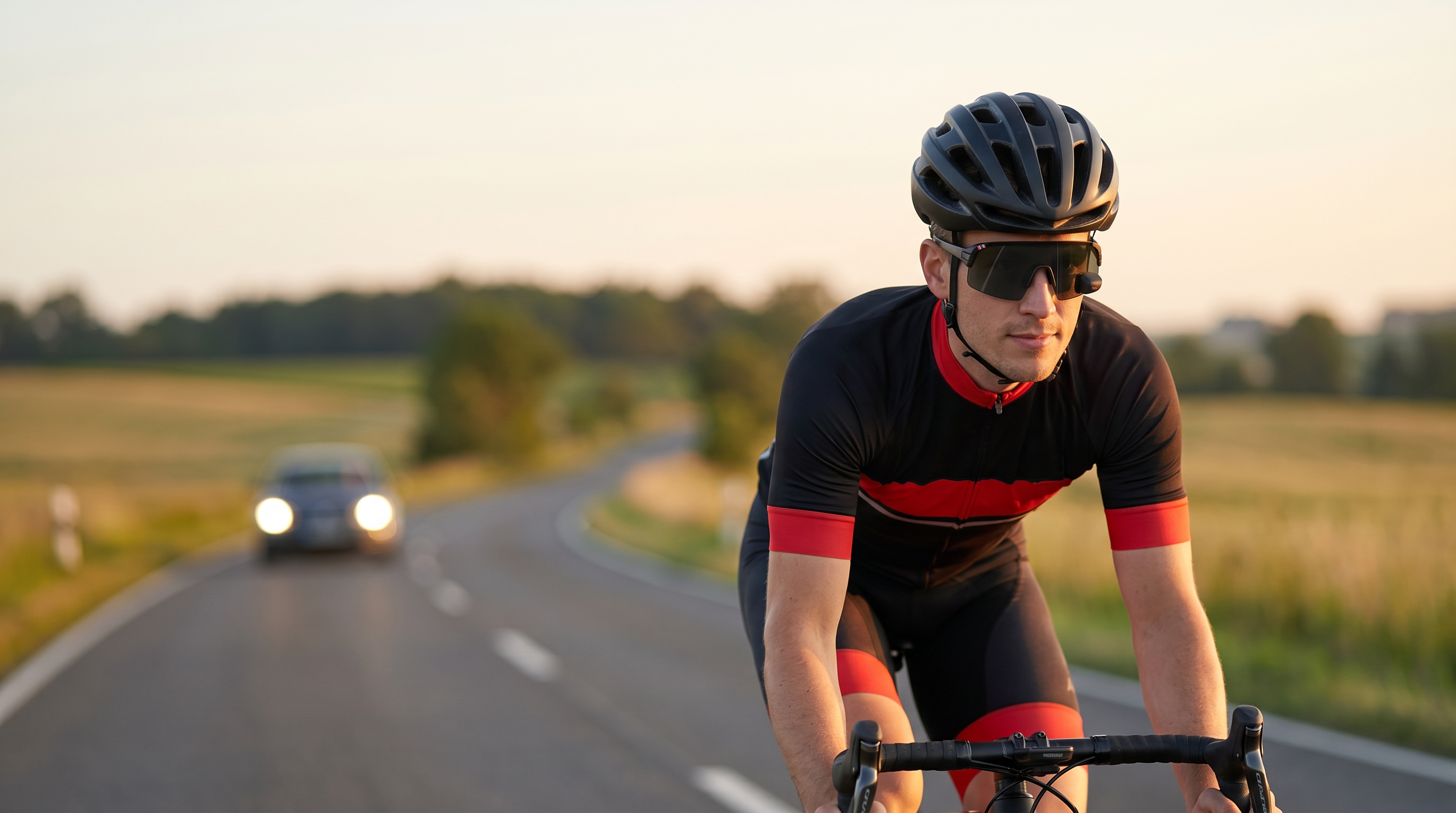
Rear-view awareness means knowing what's coming up behind you without turning your head. On a bike, a run, a scooter or in a single scull, a shoulder check costs you a second of looking forward — and a second of a steady line. A small mirror built into your sunglasses lens gives you that information back as a glance, so your eyes stay on what's ahead. It doesn't prevent anything. It just means you're rarely surprised.
Every rider knows the move. You drop your head, twist a shoulder, sneak a look back — and for about a second you're travelling forward while looking the wrong way. On an empty road that's nothing. In a bunch, on a busy commute, or with a car closing behind you, it's the least comfortable second of the whole outing.
That single, awkward second is the problem rear-view awareness solves. Not with anxiety, and not with more rules to remember — just with a steady, low-effort way to keep tabs on the space behind you. This is the idea that ties together everything we make and everything we write about, whether you ride, run, scoot or row. Here's how it works, sport by sport.
What is rear-view awareness?
Rear-view awareness is simply the habit of staying aware of traffic, people and obstacles approaching from behind — continuously, and without sacrificing your view of what's ahead. It's one slice of the broader skill of situational awareness: reading the whole environment around you while you move through it.
The catch is that humans are built to look forward. Our eyes face the direction we travel, which is brilliant for spotting a pothole and useless for clocking the car that's been sitting in your blind spot for the last ten seconds. Every sport handles that gap differently. Cyclists shoulder-check. Runners glance back. Scullers twist around mid-stroke. Each method works — and each one briefly takes your attention off where you're going.
A mirror changes the maths. Instead of turning to look, you flick your eyes. The direction behind you stops being a blind spot you have to actively check and becomes information that's just there, in the corner of your vision, whenever you want it.
Why is looking over your shoulder the problem?
Here's the uncomfortable truth about a shoulder check at speed: for the moment your head is turned, you're moving forward more or less blind, and usually drifting slightly off your line. Most of us have felt the bike wander toward the white line during a long look back. Runners step sideways. Scullers lose the rhythm of the stroke.
It's worth being honest about the risk, because we'd rather earn your trust than scare you. Being hit from behind is most cyclists' worst fear, precisely because it comes from the one direction you can't see. But rear-end collisions are actually a minority of cycling crashes — junction and turning conflicts are far more common (California SafeTREC's 2025 figures put rear-end at roughly 10% of serious bicycle crashes, versus around 35% for broadside). When a rear hit does happen, though, it tends to be severe, especially at higher rural-road speeds (NHTSA's 2023 bicyclist data).
So a mirror doesn't change your crash odds. What it changes is the blind direction and the low-grade tension that comes with it. You stop bracing for the unknown behind you, because it isn't unknown anymore.
How do you see behind you without turning your head?
There's no single magic fix — good awareness is layered. The riders we admire combine a few of these, and lean hardest on the ones that demand the least attention:
- A mirror. The lowest-effort layer. A glance, not a turn. An integrated in-lens mirror travels with your head, so it's always pointed roughly where you're looking.
- Your ears. Open ears (or bone-conduction audio) catch an engine note or a freewheel ticking up behind you before you can see it.
- Road and water positioning. Where you place yourself shapes how much room a vehicle or boat has to pass, and how visible you are.
- Rear radar. A device like a Garmin Varia pings you when something's approaching — a useful second layer that pairs naturally with a mirror for, as we like to put it, two layers of awareness.
- Communication. In a group, a called "car back" is awareness shared down the line.
Does rear-view awareness work the same across sports?
The principle is identical everywhere — keep the space behind you accounted for without losing your view forward — but the why shifts with the sport. We've built a hub for each one, so you can go as deep as you like.
| Sport | What's behind you | Why a glance beats a turn |
|---|---|---|
| Cycling | Cars, vans and faster riders closing at speed | A shoulder check on a fast descent or in a bunch drifts your line. Read the cycling guide → |
| Running | Vehicles, cyclists and people, often in low light | For solo and early-morning runners, awareness is reassurance. Read the running guide → |
| Rowing / sculling | The course ahead — which is behind your head | Scullers face the stern, so twisting to look breaks the stroke. Read the rowing guide → |
| E-scooter / commute | City traffic at junctions and pinch points | At scooter speed in traffic, you can't safely turn to look. Read the commuter guide → |
Rowing is the clearest case of all. A sculler travels toward the bow — the direction behind their own head — so "ahead" is literally over their shoulder. A mirror lets them watch the course they're heading into without breaking rhythm to twist around. Same tool, completely different blind direction.
How does an in-lens mirror actually work?
This is the part people are surprised by. The mirror isn't a gadget clipped to the temple or hanging off the arm — it's a small optical mirror integrated into the lens itself, sitting in the lower outer corner of the lens, just inside your field of view. Look slightly toward it and the road behind you appears, the way the corner of a windscreen mirror does in a car. Eyes forward the rest of the time, and you barely notice it's there.
Because it lives in the lens, the mirror moves with your head. Point your face at the road and the mirror points roughly back down it. There's nothing to adjust mid-ride, nothing to bolt on, nothing to bob loose on rough ground. We go deeper on the optics in how TriEye's integrated mirror works, but the short version is: it turns the look back into a glance.
Single or dual mirror — and which side?
You choose the setup when you buy. A single mirror sits on one side of the lens; most riders pick the wearer's left, which faces the lane traffic comes from in countries that drive on the right. A dual setup puts a mirror on both sides of the lens — popular with rowers, who want eyes on the water either side of the boat. It isn't locked in, though: TriEye lenses swap easily, so you can change your setup later.
How long does it take to get used to a mirror?
Less time than you'd think. The first few outings, you'll consciously look for the mirror. After that, checking it stops being a decision and becomes a reflex — the same way you stopped thinking about the mirrors in your car. Most people find the adjustment quick, and the moment it clicks is the moment you stop wanting to ride without one.
Dr. Jim Taylor — a sport psychologist and five-time US national age-group champion — put it bluntly after a crash on a day he wasn't wearing his: his mirrors looked "totally geeky," and he wouldn't ride without them now. That's the usual arc. A bit skeptical, then quietly converted.
Frequently asked questions
Does a rear-view mirror prevent accidents?
No, and we won't claim it does. A mirror helps you see traffic and obstacles approaching from behind without turning your head. It gives you information and a heads-up; it doesn't ride, run or row for you, and it can't change what other people on the road do.
Where is the mirror — on the temple or the arm?
Neither. The mirror is integrated into the lens itself, in its lower outer corner, just inside your field of view, so a small eye movement shows you what's behind you. There's nothing clipped to the temple or hanging off the arm to bob loose.
Which side should the mirror be on?
For a single mirror, most riders choose the wearer's left side of the lens, since that faces the lane traffic comes from in countries that drive on the right. You pick the side (or go dual, with a mirror on both sides of the lens) when you buy, and because TriEye lenses swap easily you can change it later.
Is rear-view awareness only useful for cyclists?
Not at all. Runners use it for personal safety in low light, scullers use it to watch the course they row toward, and e-scooter commuters use it in city traffic. Any activity where turning to look is awkward or risky benefits from seeing behind you with a glance.
Can I add a mirror to glasses I already own?
Yes. The Clip is a clip-on mirror that attaches to your existing frames, including prescription glasses, so you can add rear vision without changing the eyewear you already like. For a dedicated setup, The View and The Classic build the mirror into the lens.

